India Hackathon Winners Put Enterprise AI to Work on Compliance, Web Monitoring and Claims
- Gate
- AI & ML
- Departs
- Crew
- Ravindra Ramnani
- Passengers
- 875
Three Indian teams built AI systems for call reviews, frontend incident response and medical claims, using search, language tools and auditable workflows.
Three projects from India’s Forge the Future Hackathon 2026 show where enterprise AI gets more demanding: connecting model output to evidence, operational data and human review. The winning teams tackled financial sales calls, broken website journeys and medical insurance claims, with Elasticsearch supporting search and data handling across the builds.
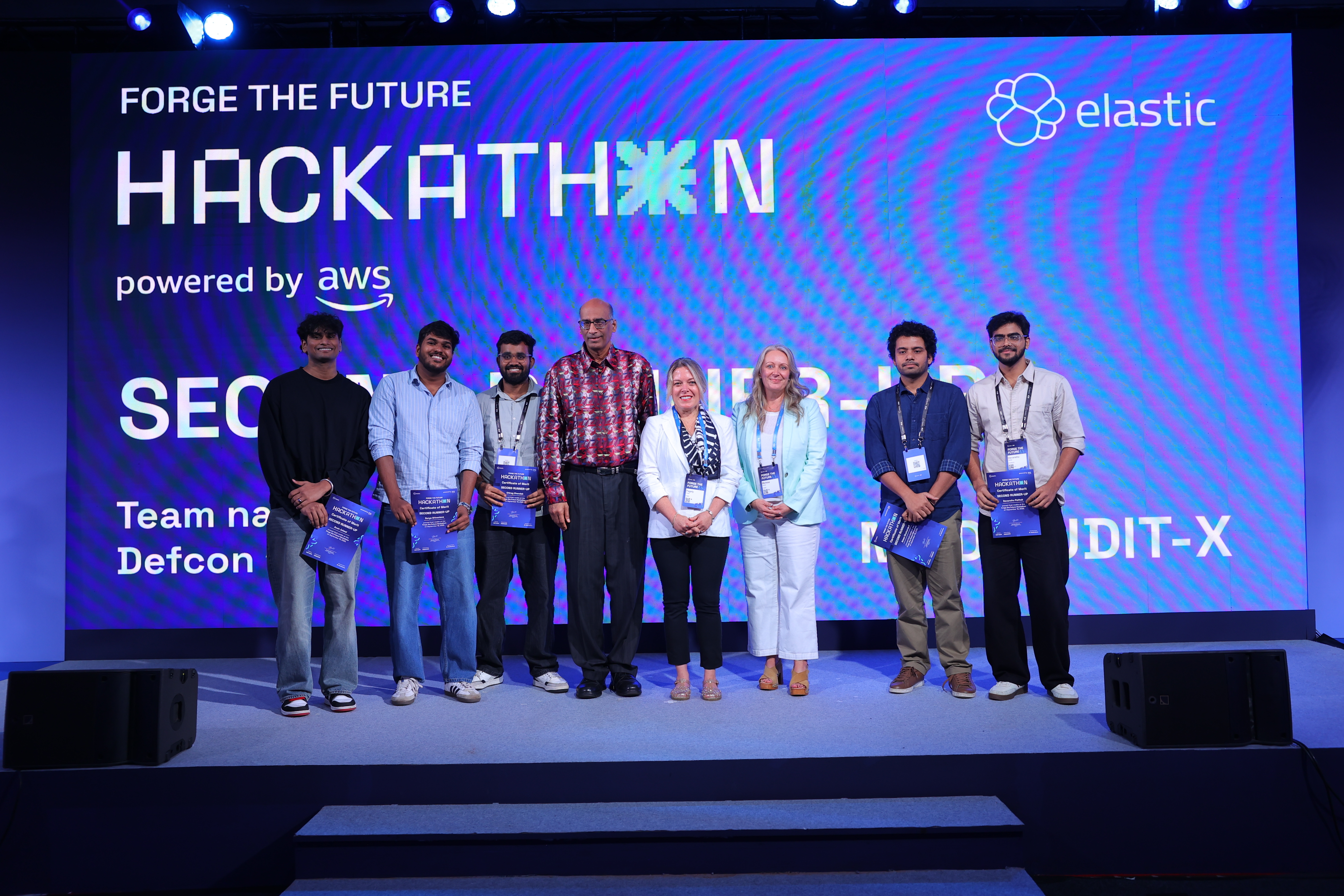
The competition began with 8,000 registrations and 300 idea submissions. Twenty shortlisted teams met at Elastic’s Bengaluru office for a two-day finale, where they developed working applications. The top three later presented their projects in the Creator Zone at Elastic{ON} Mumbai, where the winners were recognized on stage.

What the judging focused on
The judging panel included Ravindra Ramnani, Sehaj Virk, head of strategy and go-to-market at Sarvam AI; Chokalingam M, director of frontier technology at Nasscom; and AWS solutions architects Ruchikka Chaudhary and Manasvi Jain. The stated priority was whether teams could build systems suited to complex enterprise workloads, with reliability and scale treated as engineering requirements.

The 20 finalists explored problems ranging from incident reporting workflows to safeguards intended to keep AI models from taking unauthorized actions. Their work combined domain-specific reasoning with data pipelines, multilingual voice features and low-latency search. The challenge was to make these pieces operate together against live data, complex queries and unexpected inputs.

The winners were Vigil, from Team Frustrated Engineers; Eyewitness, from Team Sandboxed; and MediAudit-X, from Team defcon1. Each project addresses a different gap between an organization’s existing records and the decisions people need to make.

Vigil connects call evidence to financial rules
Asset managers and mutual fund distributors in India handle tens of thousands of customer and sales calls each day. Sales representatives must avoid unverified promises about returns and mis-selling. Manual review takes time, and the source says traditional audits cover fewer than 30% of calls, leaving many conversations unchecked.

Vigil automates part of that review. It transcribes multilingual Indian speech, indexes the resulting text, then searches across guidance from the Securities and Exchange Board of India and the Association of Mutual Funds in India. When the system detects a potentially unverified claim, it flags the point in the audio and links it to a relevant clause.

That link between transcript, timestamp and source text is the project’s practical contribution: reviewers can go directly to the evidence rather than listen through an entire recording. It still leaves people to assess whether a flagged statement constitutes a violation, but it could make broad review more manageable. The account doesn’t describe how the team measured detection accuracy, so that remains an important question for real-world use.

Eyewitness looks for failures users can see
Backend monitoring can report that servers and databases are healthy while customers encounter a broken checkout button or a layout that no longer responds. Eyewitness, built by Team Sandboxed, aims to connect these frontend failures to the systems engineers use to investigate and track issues.

Elastic monitors session signals such as dead clicks, repeated frustrated clicks and abandoned checkouts. When activity suggests a problem, the system replays the user’s session to check what happened, then creates a case containing the failure moment, a short recording and related backend information. The project also uses AWS to review recordings and Sarvam to produce summaries in Hindi or Tamil for on-call teams.

The workflow is designed to give engineers context alongside an alert. A session replay can help show what a customer experienced, while the backend trail may help narrow down the cause. The source doesn’t explain how the system distinguishes a genuine product defect from an unusual but harmless session, or how it handles sensitive information in recordings. Those details matter when teams consider putting this kind of monitoring into production.

MediAudit-X structures claim review
Medical insurance claims can require reviewers to compare hospital paperwork, discharge summaries and lab results with policy terms and treatment records. That manual work can delay decisions, add administrative effort and produce inconsistent records.
MediAudit-X gives both hospitals and reviewers a structured workflow. Hospitals upload documents and receive a structured claim. Reviewers get recommendations with cited policy rules, treatment history and drug-safety checks. Elastic stores claim information, searches the policy material and maintains a record of the process; AWS handles document reading and review steps.
Recommendations are presented with cited rules for individual line items, so a reviewer can inspect the basis for each one. Approved claims are then recorded in a tamper-resistant audit log. The design keeps a human reviewer in the process while making the supporting material easier to follow. The source doesn’t specify how the system performs on poor-quality documents or conflicting records—common conditions that can shape the effort required to adopt a document-heavy workflow.
Production work depends on the surrounding stack
The event paired Elastic’s search and data capabilities with AWS cloud computing and AI inference services, including Amazon Bedrock, SageMaker and AgentCore. Sarvam AI contributed Indian-language speech and text capabilities, while Nasscom AI and HackCulture supported developer participation across the country.
The projects suggest that production AI work involves more than selecting a model. Each team had to connect information from different sources, retrieve relevant context and make the output useful within an existing operational process. For engineering teams, the lasting test will be whether these systems remain accurate and explainable as data changes and edge cases accumulate. The hackathon offers a view of the designs; deployment experience will show how well they hold up.