Elastic Search and Observability Support Audi Revolut F1 Engineering Investigations
- Gate
- AI & ML
- Departs
- Crew
- Melissa Rigney
- Passengers
- 829
Audi Revolut F1 uses Elastic to search engineering software logs and telemetry, with broader Search and Observability work planned from 2027.
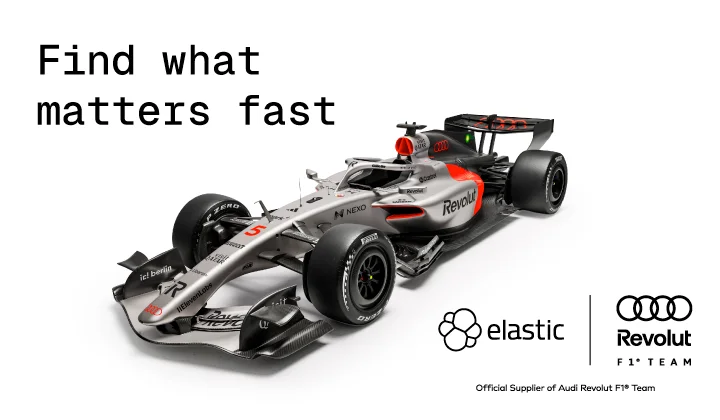

For Audi Revolut F1® Team, the practical value of Elastic is in helping engineers investigate problems across connected engineering software. The team already uses Elastic in that environment, where relevant operational signals can be spread across multiple applications. A multi-year agreement will extend the relationship: Elastic is Race Partner for the 2026 United States Grand Prix in Austin, scheduled for October 23–25, and is set to become the team’s Search and Observability Supplier from 2027.

The technical story is more specific than a new supplier label. Elastic describes a system for collecting application logs, making them searchable, and presenting them for analysis. That can give engineers a shared view of activity across systems, primarily in the factory, when they need to trace an error or understand a failure. The source does not give performance measurements, deployment details, or named incidents, so the value here is best understood as an investigation workflow rather than a quantified speed improvement.

Following a problem across connected software
The team’s engineering work depends on a network of applications, and reliability matters when those systems support time-sensitive operations. A problem may leave clues in more than one place. Engineers need to find the useful data, connect it to what happened, and narrow down where to investigate. Searching each system separately can make that process harder to follow.

Elastic’s components have distinct roles in the workflow described by the company. Logstash collects and processes application logs. Elasticsearch indexes the data so it can be searched. Kibana provides dashboards and analysis. Together, those tools let engineers inspect logs, metrics, and other telemetry from a unified operational view, then search for signals related to an issue.

That arrangement is familiar to teams working with distributed software: telemetry is only useful when people can find and interpret it in context. Central search can help an engineer move from an observed error to related records across connected applications. Dashboards can make recurring patterns easier to spot, while access to the underlying data supports deeper investigation. The source says engineers can search in milliseconds, but offers no benchmark conditions or comparison with the team’s previous tools.

The stated use is support for investigations across engineering software, primarily in the factory environment. The article does not say that Elastic controls car systems, makes engineering decisions, or replaces existing applications. That distinction matters: a search and observability layer can help people understand system behavior without itself resolving every cause of an incident.

AI depends on operational context
Elastic also points to a possible role for the same data in AI-assisted work. Telemetry could be combined with past incidents, runbooks, and other operational knowledge to give AI systems useful context when identifying likely causes or suggesting remediation. In practice, the quality of those suggestions would depend on whether the underlying records are relevant, current, and connected to the problem at hand.

The company says engineers would remain in control of decisions. No particular AI feature, deployment schedule, or measured result is described, so this remains a direction for exploration rather than a delivered capability at the team. For engineering organizations, the underlying point is straightforward: AI support depends on access to operational knowledge, and collecting that material in a searchable system may make it easier to retrieve when an issue arises.

What changes from 2027
From 2027, Elastic and Audi Revolut F1® Team plan to explore how Search and Observability can support more of the team’s engineering environment. They say specific use cases will be shared after development and validation. That leaves open the questions practitioners will care about: which systems will be included, how data access will be managed, what migration work will be needed, and whether the expanded deployment changes investigation time or service reliability.

There are no details yet on pricing, compatibility requirements, or how the team will evaluate results. Those will matter to other organizations considering a similar approach, since the effort depends on the variety of existing systems and the quality of their telemetry. A unified search layer can reduce the effort of moving between data sources, but it still relies on useful instrumentation and clear operational practices.
At the 2026 United States Grand Prix in Austin, Elastic branding is planned for the Audi R26 halo and headrest. That visibility marks the start of the public relationship, while the more consequential test comes later: whether the existing engineering use expands into validated workflows that make it easier to locate evidence and diagnose issues. The team and Elastic say they will share those use cases as they develop.
Source: Melissa Rigney