Keybytes Keyboard Uses Modular, Microcontroller-Equipped Keys for Custom Layouts
- Gate
- AI & ML
- Departs
- Crew
- Mark Tyson
- Passengers
- 393
Keybytes connects magnetic, 1U keys to a central hub, offering unusual layout flexibility with a steep build cost and substantial assembly work.
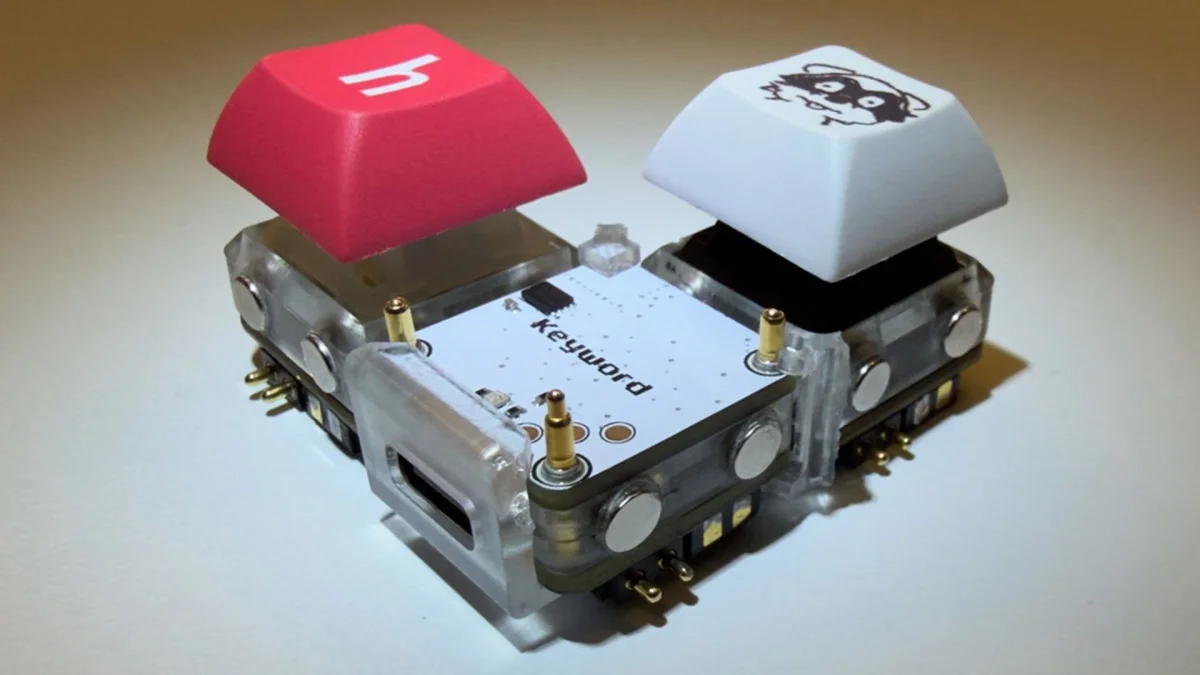
Keybytes changes the keyboard design question from “which layout should I buy?” to “which keys do I want to connect?” Developer Nathan Alspaugh’s open hardware project pairs a central Keyword hub with individual Keybit modules, each built around its own microcontroller. The magnetic modules can connect along any side, letting users arrange keys into custom shapes rather than starting from a fixed plate.
That flexibility comes with a practical tradeoff: every key is a small electronics assembly, and a large keyboard multiplies the parts and build effort. Alspaugh estimates that a full-size setup with two Keywords and about 110 Keybits would cost around $900 assembled. Keybytes is an early working prototype, so the design’s appeal today is its modular architecture and shared build files, while affordability and scaling remain open questions.
A hub and independent key modules
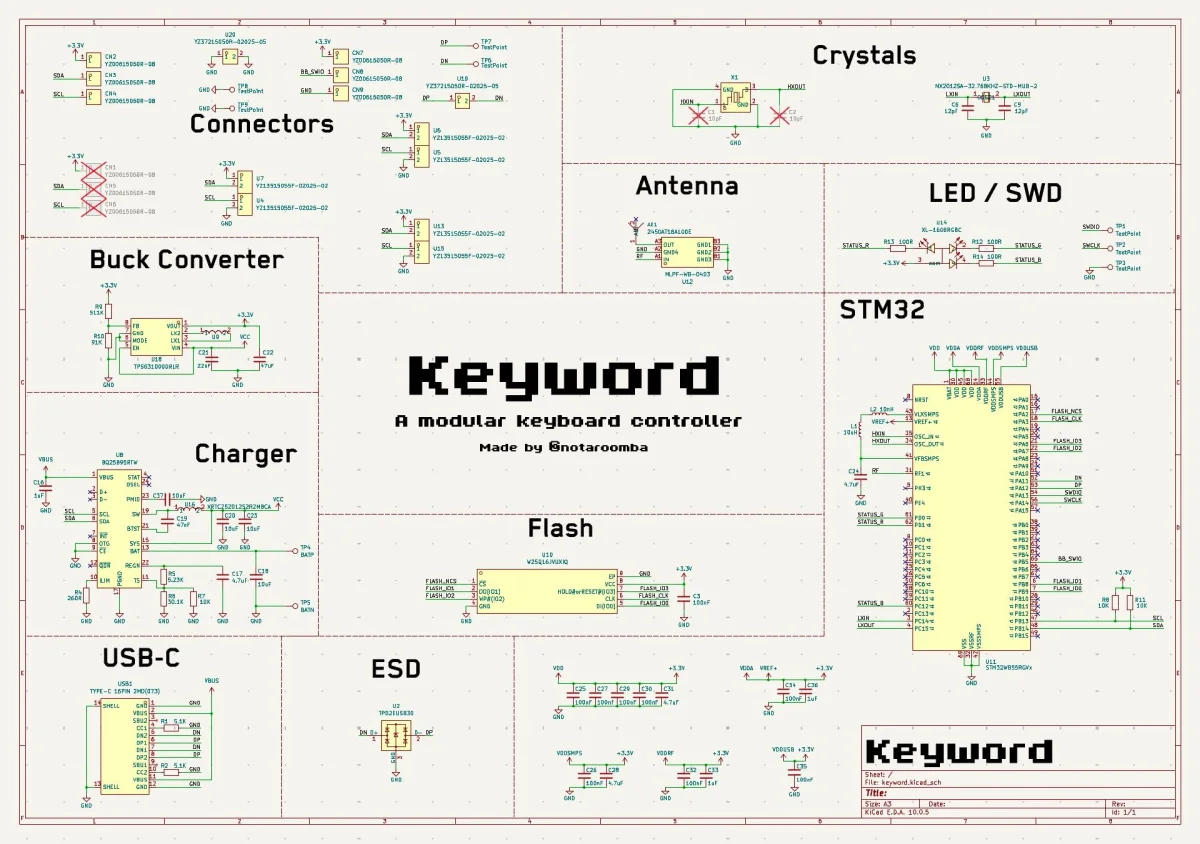
The Keyword is the system’s central board and connection point. It uses two stacked PCBs: the upper board carries an Arm Cortex M4 microcontroller, Bluetooth antenna and flash memory; the lower board provides USB-C, charging and a buck-boost converter. This puts the main computing and power functions in the hub, while each Keybit handles its own key input.
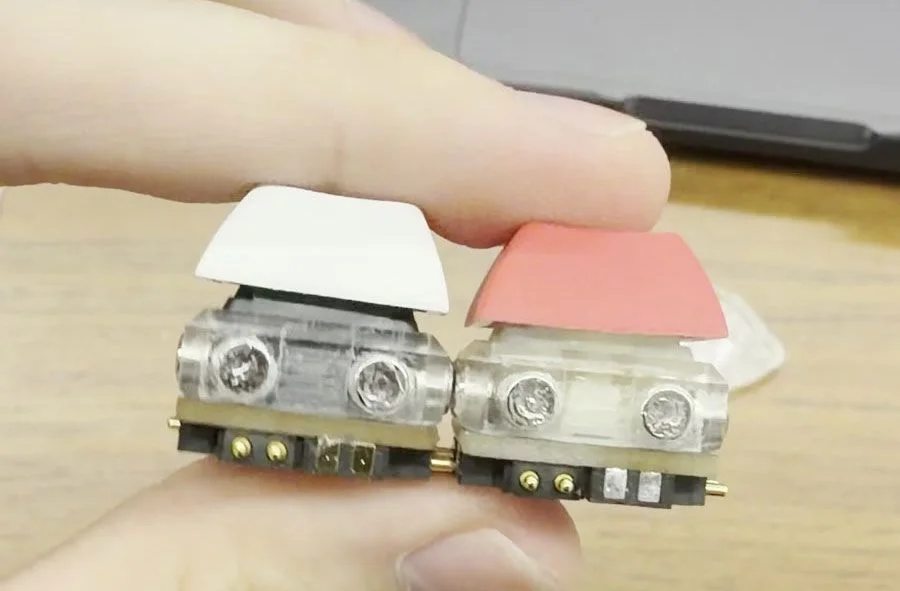
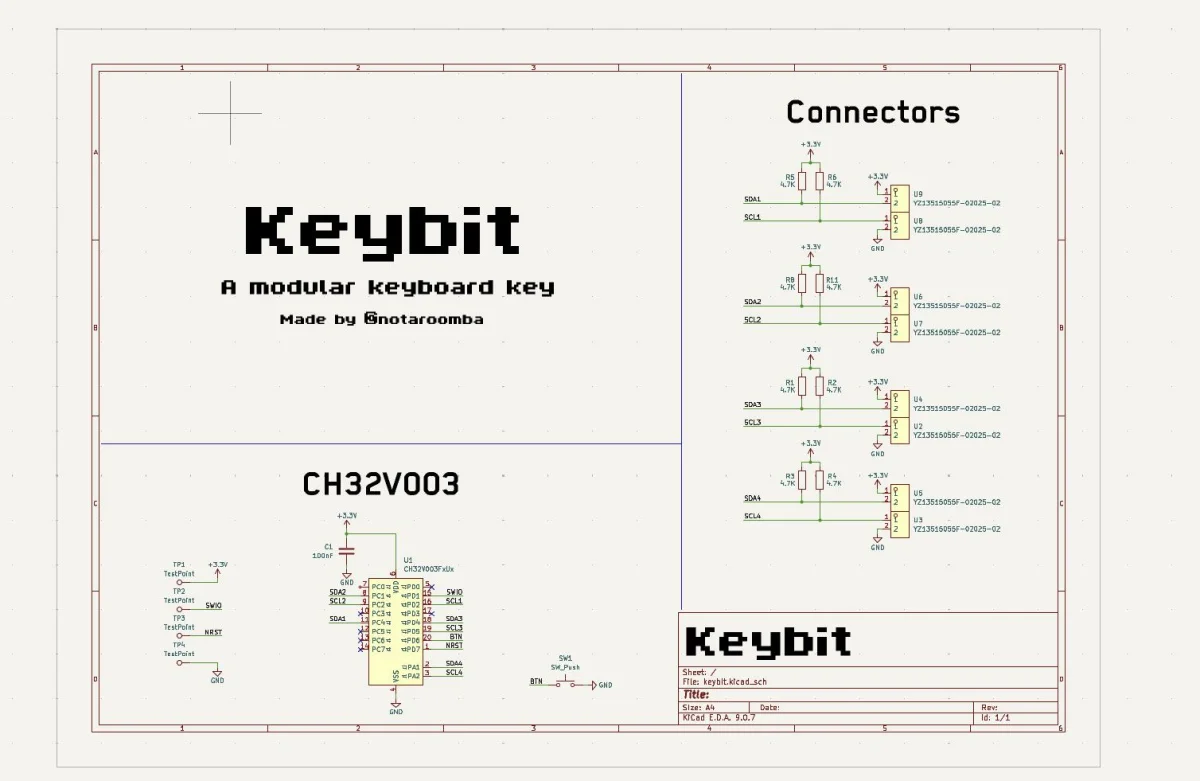
Each Keybit contains a CH32V003 RISC-V microcontroller and pogo pins on all four sides. Those contacts carry power and I2C between modules. A magnetic case holds neighboring units together, and the same connection lets a Keybit attach to any side of the Keyword. The result is a grid that can expand or change direction without requiring a conventional keyboard-sized circuit board.
Both the hub and the key modules measure one unit, or 19.05 by 19.05 mm. A Keybit has a Cherry MX switch on top. The project’s design may allow builders to choose a preferred compatible mechanical switch, though the available source does not describe a tested list of alternatives or explain any switch-specific limitations.
Flexibility is the main technical distinction
Most custom mechanical keyboards let users choose a layout before building, but their switches sit on a board designed around that arrangement. Keybytes moves the boundary: each key is a separately addressable module, so the layout can be assembled from individual pieces. That could suit compact shortcut clusters, unusual ergonomic arrangements or other layouts that don’t fit a standard rectangle.
There is a cost to that approach. A microcontroller and connector on every key add parts and assembly steps compared with a design that shares one controller across the board. The four-sided contacts and magnetic cases make rearrangement possible, but the project details provided so far don’t establish how a large, frequently reconfigured layout will hold up in daily use. Nor do they specify performance, battery life, wireless behavior under different layouts or compatibility with particular operating systems.
Keybytes has so far been shown with just two Keybits connected to a Keyword. The project journal says work began in March and records Alspaugh’s first report that the system was working over a recent weekend. That is enough to demonstrate the core idea, but not yet to show what a large layout looks like or how the design behaves as the number of modules grows.
Open plans, demanding build
Alspaugh, an MIT student, has shared the project’s assets, files and build details on GitHub under the permissive MIT license. That gives technically capable builders a route to make the hardware and adapt it, while also making the current design easier for others to inspect and develop.
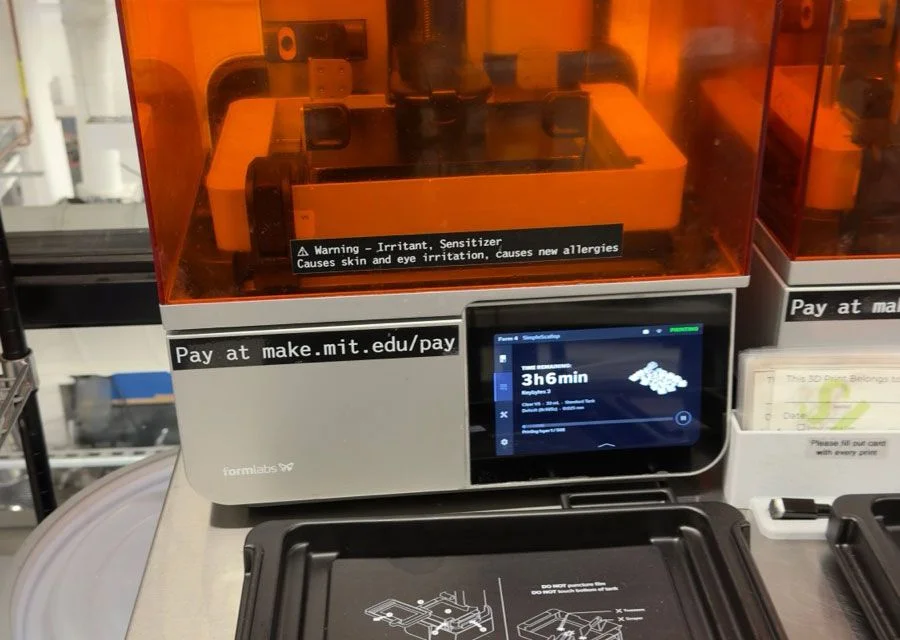
But open files don’t remove the work of producing the keyboard. Builders need to have the PCBs made, buy and solder components, and produce the custom cases. For a handful of keys, that may be a manageable experiment. Scaling to a typist’s full layout means repeating those steps many times, and the developer’s estimate of about $900 for two hubs and roughly 110 Keybits puts the potential cost in sharp focus. The estimate is for an assembled build; the source doesn’t break down parts, labor or other costs.
The current design also leaves room for features that may matter to everyday use. The Keyword has a status light, while the Keybits have no lighting. Alspaugh’s wishlist for a later version includes customizable RGB lighting, plus possible Dialbit, Fingerprintbit and Touchpadbit modules. These are ideas rather than announced features, but they point toward the broader promise of the system: treating a keyboard as a collection of input components, not only keys.
For now, Keybytes looks most compelling as a platform for experimentation and highly specific layouts. Its next meaningful test is whether the modular connections, build process and per-key cost remain practical beyond a small prototype. The repository gives makers a place to start; a larger working build would show whether the concept can serve as a daily keyboard.