Tachyum’s Prodigy Processor Faces an Uncertain Future After Slovak Subsidiary’s Bankruptcy Filing
- Gate
- AI & ML
- Departs
- Crew
- [email protected] (Anton Shilov)
- Passengers
- 784
After years of delays and major redesigns, Prodigy still lacks demonstrated silicon. Its future may hinge on who owns the chip’s technology and whether a buyer will fund development.
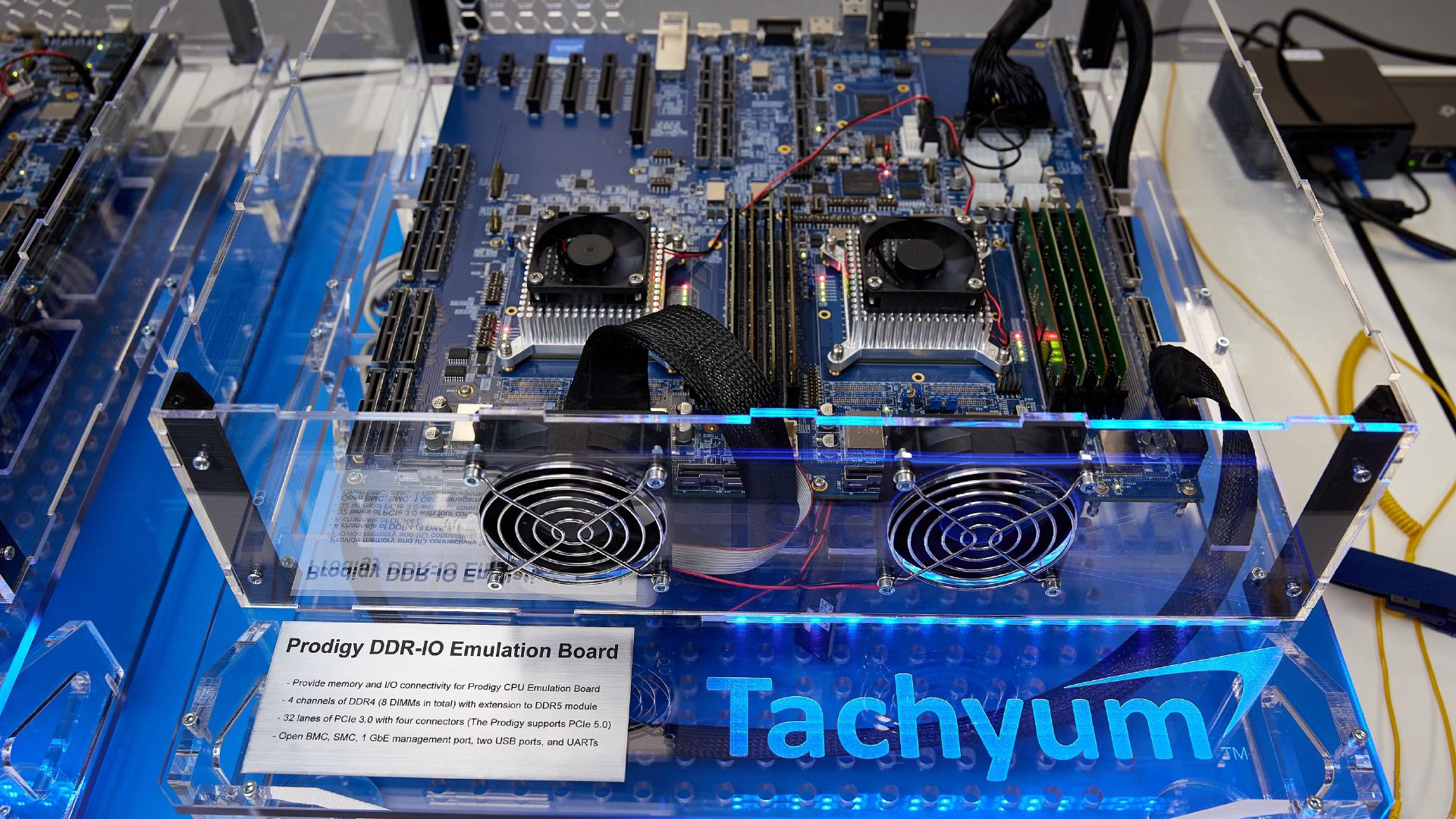
Tachyum’s Prodigy processor has reached a more consequential milestone than any of its announced specifications: the company’s Slovak subsidiary has filed for bankruptcy. After eight years of development claims and repeated schedule changes, no working Prodigy silicon has been demonstrated. The filing now raises a practical question for anyone tracking the project: who controls its technology, and is there a path to fund the work still required?
According to Forbes, Tachyum Slovakia filed voluntarily in Bratislava on October 22, 2026, before creditors filed a petition to recover unpaid debts. The Bratislava III Municipal Court then began bankruptcy proceedings after finding that the filing met the required criteria. Forbes reports that Slovak law presumes a company insolvent when it makes such a filing.
If the court formally declares the company bankrupt, an appointed trustee would take control of its assets, which could be sold to repay creditors. The available accounts don’t establish which entity owns each asset. Potentially relevant property could include Prodigy patents and other intellectual property, as well as development hardware. That ownership question matters: the subsidiary’s financial position alone doesn’t tell us whether the chip’s design can continue under another company.
A moving target for eight years
Tachyum introduced Prodigy in 2018, initially targeting a 2019 tape-out and commercial availability in 2020. The company subsequently moved the launch target to 2021, then 2022, 2023 and 2024, before pushing it to 2025. The project’s changing schedule has come alongside substantial changes to its technical plan.
The initial design called for 64 cores. Later versions were described as a 128-core processor on a 5nm-class manufacturing process, then as a 192-core chip with 16 DDR5 memory channels. In late 2025, Tachyum outlined a new chiplet design: 1,024 cores, 24 DDR5 memory channels and a 1,600W thermal design power, using TSMC’s 2nm-class process.
That last proposal would require substantial additional engineering, and the company’s own revised timeline placed commercial availability in 2030 or later. Those specifications describe an intended design, not demonstrated product capability. Without working silicon, there’s no way to assess how the design performs, whether it can be manufactured as described or what system builders would need to support it.
For engineers and prospective customers, that gap between a specification and a working processor is decisive. A chip with a large core count and many memory channels still needs functioning silicon, a production plan and a software environment that makes its hardware useful. The source material offers no demonstrated chip or concrete compatibility details. Until those arrive, Prodigy remains a development proposal whose scale has changed repeatedly.
Several possible paths for the technology
Bankruptcy proceedings for Tachyum Slovakia don’t automatically establish what will happen to affiliated companies in other countries. The Slovak subsidiary is reported to be part of U.S.-based Tachyum Inc., while much of the development activity has been concentrated in Slovakia. The company structure therefore leaves open several possibilities for the intellectual property.
If the Slovak company owns the Prodigy IP, it could become part of the assets managed through the proceedings and might be acquired by a buyer able to continue development. If Tachyum Inc. owns the IP, the parent might retain it while the subsidiary’s operations wind down. The technology could also change hands or be transferred to another entity, although the available reporting doesn’t establish that any of these outcomes has happened.
There is a further complication: Dennik N reports that creditors have also sought the liquidation of the U.S. parent. If that account is accurate, the parent’s ability to preserve or support the project is also uncertain. A buyer might value Prodigy’s design rights, but acquiring those rights would not by itself provide the engineering capacity or financing required to finish the processor.
It’s theoretically possible for development to resume under new ownership or after a restructuring. But there’s no evidence in the reporting that a buyer has committed to the project, that funding is available, or that Prodigy has reached a stage where another team could take over with a finished design. The next meaningful signal would be clarity on which entity owns the IP and whether an organization with the resources to continue the work emerges.
For now, Tachyum’s filing makes the future of Prodigy harder to read, not easier. The subsidiary’s bankruptcy could end its role in development while leaving the processor’s underlying technology elsewhere in the group. Whether that distinction becomes a route to continued work or merely preserves an unbuilt design will depend on ownership, financing and evidence of technical progress.
Related reading:
- Intel VP Robert Hallock sets Nova Lake expectations, teases return to Raptor Lake for DDR4 platforms
- CPU scaling with DLSS
- Intel's one-two punch plan in desktop CPUs is taking shape
- Benchmarking AMD's BC-250, offering Steam Machine-like performance at half the price
- AMD splits Zen 7 into three EPYC families for 2028 and starts selling server CPUs by the agent