Elastic’s Enterprise AI Search Ranking Highlights Retrieval and Agent Tooling
- Gate
- AI & ML
- Departs
- Crew
- Loren Erickson
- Passengers
- 628
Elastic ranked first for AI Automation in Gartner’s 2026 assessment, pointing to retrieval, agent-building tools and data flexibility as key strengths.

Elastic’s strongest result in Gartner’s 2026 Enterprise AI Search assessment came in AI Automation, where it ranked first among evaluated vendors. The result puts a focus on a practical question for teams moving AI agents into production: can their search layer retrieve useful context across enterprise data, then support workflows that act on it?

Elastic was named a Leader in the Magic Quadrant, placing highest for Ability to Execute and furthest for Completeness of Vision among the vendors assessed. In Gartner’s companion Critical Capabilities report, the company scored 2.77 out of 3.0 for AI Automation, the top score for that use case. Elastic also ranked second across the other five use cases: Deep Research, Context Engineering, AI Augmentation, Digital Workspace and Enterprise Applications.

Those results are Gartner’s assessment, while Elastic’s interpretation is that its search and retrieval platform fits a market shifting from AI experiments toward deployed applications and agents. The ranking offers a useful signal for buyers, but it doesn’t answer the implementation questions that matter inside a particular organization: how well retrieval works on its data, what operating costs look like, and how much work integration will require.

Retrieval is the product’s center of gravity
Elastic’s pitch rests on Elasticsearch serving as a context layer for AI applications. The system combines full-text, semantic and hybrid search to find relevant material across structured and unstructured data. That context can then be supplied to an application or agent before it generates an answer or takes an action.

The approach targets a familiar failure mode in generative AI: a model can produce fluent output while lacking the information needed to answer a specific question. Elastic argues that missing or weak context can contribute to hallucinations, irrelevant results and higher token use. Better retrieval can ground responses in company information and may reduce the amount of unnecessary material passed to a model.

This emphasis also clarifies Elastic’s product boundary. The company is positioning Elasticsearch as infrastructure for assistants and agents, rather than presenting its own end-user assistant as the main offering. For engineering teams, that means the value depends on how effectively they can connect retrieval to their chosen models, applications and workflows.

What supports the AI Automation result
Elastic attributes its leading AI Automation score to several pieces working together. Elasticsearch supplies search across different data types; Elastic Agent Builder and Elastic Workflows provide tools for constructing agent pipelines and connecting them to enterprise data sources. These components are intended to help developers build agents that retrieve information, reason over it and carry out tasks with less continuous human direction.

The platform also includes Jina embedding and reader models, including optical character recognition models. Elastic says these can help customers process and index a wide range of input data. The practical implication is that retrieval quality depends on more than the search query: documents first need to be read, represented and indexed in a form the system can search. How well that works will vary with data quality and workload, so teams will need to assess it against their own sources.

Another part of the toolkit is the open Agent Skills repository. It offers prebuilt skills that let agents work with Elasticsearch from Claude, Codex, Gemini and other environments, including querying data, running ES|QL and reasoning over results. This can shorten the path to a prototype, though production deployments still require teams to validate permissions, workflow behavior and the quality of the agent’s outputs.

Open roots and deployment choice
Elastic points to its open source history and a global community of engineers as advantages for organizations assessing long-term platform fit. A pool of practitioners who already know the technology may make hiring and onboarding easier. The company also cites deployment flexibility, including on-premises installations and cloud environments chosen by customers.

Those factors can influence platform dependence and operating options, but they don’t remove the work of running a search system. Buyers still need to weigh the skills available in their teams, the data sources they must connect and the infrastructure they already operate. Elastic’s reach across more than 18,000 organizations provides a sense of the platform’s footprint, though it does not establish how a specific deployment will perform.

Recent additions and what comes next
Elastic’s recent product work has centered on vector search and AI retrieval. The company acquired Jina AI in October 2025, and says Jina models, readers and rerankers are now available to its customers. Other additions include Elastic Agent Builder, an Elasticsearch Vector Database serverless offering, and changes intended to reduce the cost and complexity of running AI workloads at scale.
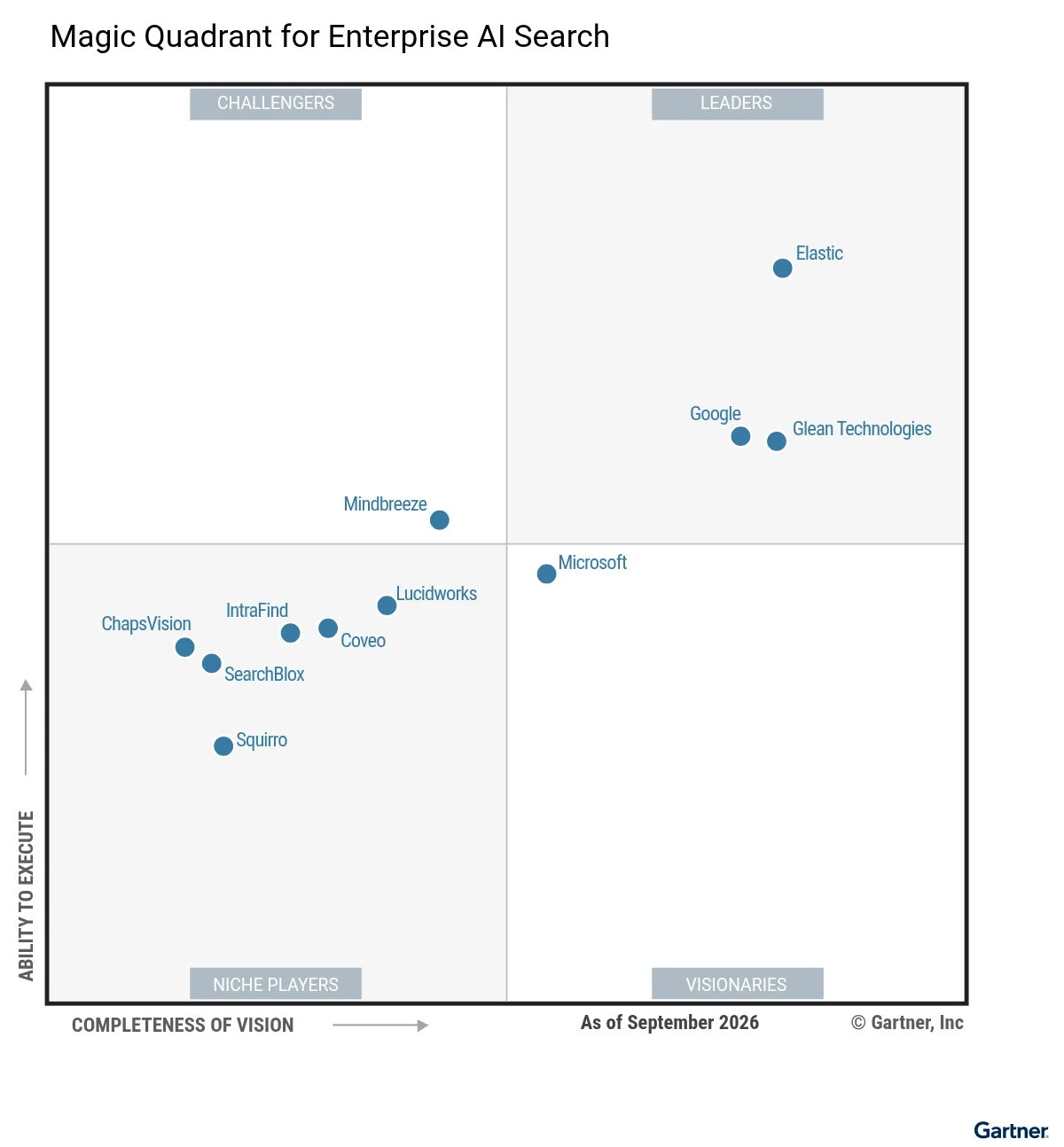
The roadmap includes a native Context Engine, advances in data federation, and improvements to built-in evaluation and model capabilities. These plans point to the next areas to watch: whether Elastic can make retrieval easier to assess, connect more data without adding operational friction, and help teams move agent workflows from demos into dependable services. The report’s ranking is a market signal; the deciding evidence for buyers will be how those capabilities perform with their data, workloads and cost limits.
Read the 2026 Gartner Enterprise AI Search report for the full assessment. Gartner’s reports are dated October 7, 2026, and list Tim Nelms, Stephen Emmott, Darin Stewart and Jed Cawthorne as authors.