PsiQuantum’s 1.2 dB Optical Switch Targets AI GPU Networks
- Gate
- AI & ML
- Departs
- Crew
- Shane Downing
- Passengers
- 957
PsiQuantum’s compact switch posts low signal loss without amplification. Its next test is scaling to the port counts used in data centers.
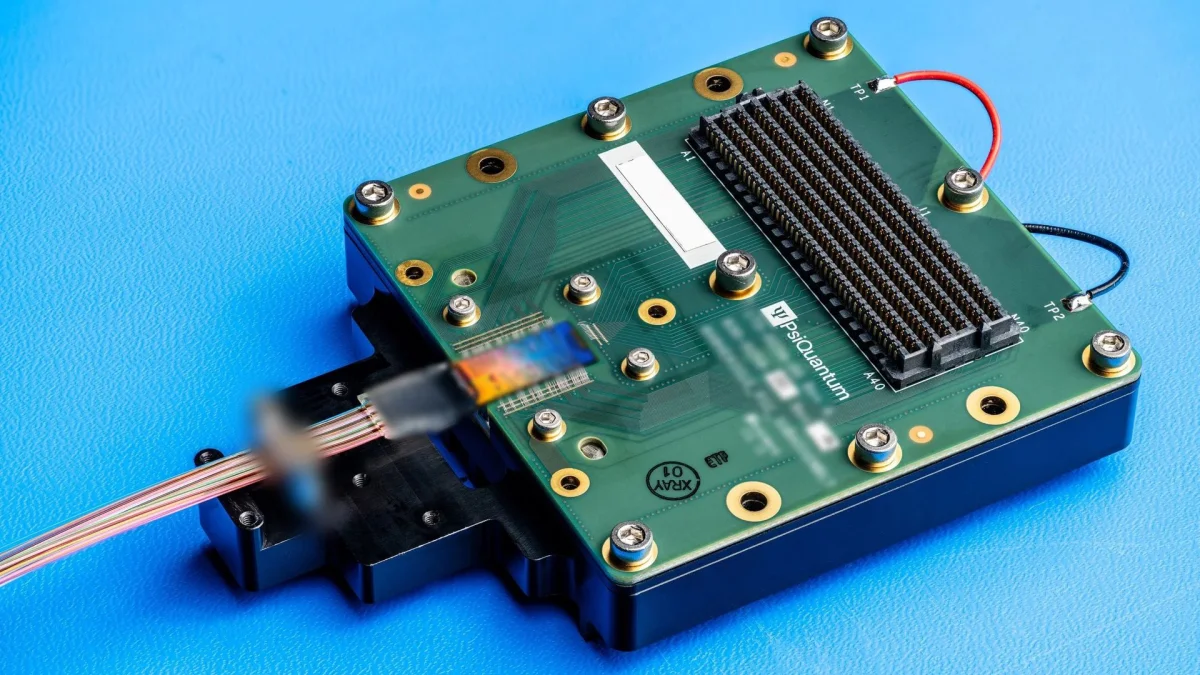
PsiQuantum’s optical circuit switch (OCS) is notable for how little light it loses, not for how many connections it handles. Its 8×8 demonstration device recorded typical insertion loss of 1.2 dB in lab tests, about a quarter of the signal, without an optical amplifier. That puts it below the 2–3 dB range the company says is workable for data center links. But eight inputs and eight outputs leave it far smaller than products from Google and Lumentum. The practical question is whether PsiQuantum can preserve its low-loss results as it builds larger devices.
Keeping data in the optical path
An OCS connects fibers by routing light directly from one to another. Conventional packet switches convert optical signals into electrical ones and back at each hop, consuming power and adding latency. An OCS avoids those conversions while a connection stays in place; changing the route requires reconfiguring the switch. That makes it suited to tasks such as rearranging connections between GPU racks, alongside ordinary packet switching.
PsiQuantum’s design uses circuits etched into a silicon photonics chip, with no moving parts. Google’s Palomar and Lumentum’s R300 instead steer light with tiny mechanical mirrors, part of a class of devices known as microelectromechanical systems, or MEMS. The approaches make different tradeoffs: chip-based designs avoid mechanical movement, while the mirror-based products already handle many more ports.
That difference shows up in the available figures. Google’s 136×136 Palomar typically stays below 2 dB of loss, with 2 dB as its worst case, and reconfigures on a millisecond scale. Lumentum’s R300 has 300×300 ports and typically starts near 1.5 dB, according to the company’s switching general manager in Gazettabyte; its reconfiguration time wasn’t stated in the source. Salience Labs’ amplified silicon photonics switch has 32×32 ports, loss below 2 dB, and reconfiguration under 300 microseconds. iPronics also claims sub-300-microsecond reconfiguration for its 32-port ONE-32, but hasn’t published a loss figure. Those comparisons use figures reported by the respective companies or cited sources, rather than a common independent test.
PsiQuantum says every input on its prototype can connect to every output, and that the switch is strictly non-blocking: adding a connection doesn’t interrupt existing ones. The company measured 40 dB of crosstalk, equivalent to about 0.01% of light leaking into other ports, and reconfiguration in under 3 milliseconds. It says each result exceeded the initial target for the device. The 1.2 dB loss figure measures the fiber-to-fiber path, including coupling light onto and off the chip but excluding connector losses, PsiQuantum told Tom’s Hardware Premium.
Why loss matters as networks grow
GPU clusters depend on fast data movement between processors, and that traffic can constrain performance as systems expand across racks. Optical links can carry data farther than copper, though the supply of lasers is another constraint discussed in industry reporting. An OCS aims to let a data center change which GPUs connect without repeatedly converting signals along the route. The amount of signal lost in the switch matters because the optical modules at either end must still receive enough light to operate.
Acceptable loss depends on those modules. Coherent says its transceivers can tolerate up to 3 dB of additional insertion loss from an OCS. Lumentum has said 3 dB can work with standard FR4, DR4, and DR8 modules, which connect GPU servers and switches across distances of 500 meters to 2 kilometers. PsiQuantum designed its 8×8 for the O-band wavelength used by these modules, and says a switch needed less than 2–3 dB to be practical. The company also says the prototype falls well below a 3 dB target in an Nvidia request for proposals.
The low-loss results build on PsiQuantum’s photonics work for quantum computing. Its silicon photonics platform is designed to limit signal loss at each stage. A 2025 paper in Nature reports silicon nitride waveguides with loss as low as 0.5 dB per meter, alongside very low losses at splitters and waveguide crossings. PsiQuantum has also reported best-case chip-to-fiber coupling loss of about 60 millidecibels, or roughly 1.4%, in lab results without a full fiber array attached.
Those component measurements help explain the design’s promise, but they don’t establish how a much larger switch will perform. Light encounters more components as port counts rise, and each component adds loss. PsiQuantum says it has taped out a 64×64 version and is developing a 72×72 device, with larger designs in progress. It expects loss to remain low, though it may rise somewhat with scale. The company hasn’t shared detailed specifications for those products.
Speed and scale are the next tests
For current OCS uses, low loss and port count may matter more than the fastest possible reconfiguration. Google uses its switches to resize TPU pods and route around failed chips; millisecond-scale changes suit those jobs. PsiQuantum’s under-3-millisecond result is in the same broad range. Salience and iPronics claim faster changes, below 300 microseconds, and iPronics has described rewiring a network during workloads so GPUs can compute while the route changes. The right speed depends on how often a network needs to be rearranged and whether that work can happen during computation.
PsiQuantum has a faster material option in its research portfolio. Barium titanate changes how it bends light when voltage is applied. The company says it chose the material over the more common lithium niobate because it produced a stronger effect, allowing short switching elements and low losses. PsiQuantum already uses barium titanate in a 64-port switch for its quantum systems, where light must switch at gigahertz rates. The company says that route could be roughly a million times faster than the 8×8 demo, but it isn’t part of the demonstration device or initial products, which use a thermally switched silicon nitride platform.
For now, optical circuit switching is established within Google, which has deployed tens of thousands of switches, while adoption elsewhere remains at the proof-of-concept and early-trial stage. Cignal AI expects most deployments to stay within Google through the end of the decade, though it has raised its market estimates for 2026 and 2029. PsiQuantum says it has sent samples and test kits to several computing companies, including GPU vendors and hyperscalers, and expects to announce commercial products in the coming months.
The company’s push into data center networking also draws on its work in quantum photonics, and Nvidia has collaborated with PsiQuantum on GPU-to-quantum-processor integration and silicon photonics. Nvidia has also backed rival iPronics, which is developing a second-generation optical switch. Salience has demonstrated a 64-port device and has described plans for 128- and 256-port products. PsiQuantum’s low-loss results make its larger designs worth watching; the key evidence will be whether those figures hold when more fibers and optical components share the chip.